
Bhubaneswar: The Odisha government is set to enhance the state’s power infrastructure significantly with the approval of a ₹15,948.70 crore investment plan aimed at modernizing and expanding the power transmission network.
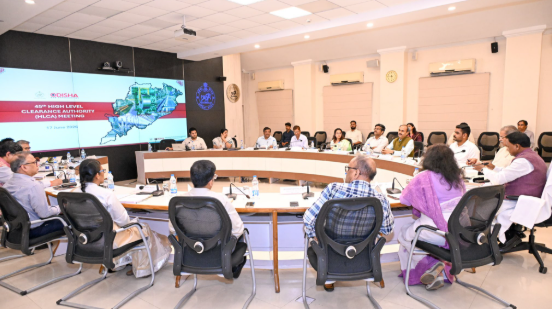
This initiative, which was greenlit during a Cabinet meeting led by Chief Minister Mohan Charan Majhi at Lok Seva Bhawan on Monday, marks the largest single investment in the state’s power sector.
The proposed expansion seeks to establish a more robust and dependable transmission system that can accommodate Odisha’s increasing industrial, urban, and renewable energy demands.
A notable aspect of the plan is the introduction of a 765-kV transmission network in Odisha for the first time. The project includes the construction of three new 765-kV Grid Sub-Stations (GSS) at Khuntuni, Duburi, and Kolabira, which are intended to support industrial development, address growing domestic needs, and facilitate the integration of renewable energy into the state grid.
Furthermore, the plan will see a substantial expansion of the 400-kV transmission network. Currently, Odisha operates five 400-kV Grid Sub-Stations, with six more under construction. The Cabinet has approved two additional 400-kV GSSs at Kansbahal and Titlagarh, bringing the total to 13.
The expansion will also extend the 400-kV network of the Odisha Power Transmission Corporation Limited (OPTCL) into western Odisha, beyond Jharsuguda.
Additionally, the 220-kV network will undergo significant growth. As of June 2024, Odisha had 48 220-kV Grid Sub-Stations, with six added in the past two years and 11 more currently being built. With the Cabinet’s approval of 10 additional 220-kV GSSs, the total is expected to reach 75.
This enhanced network is anticipated to fortify the 220-kV ring systems in regions such as Rourkela, Sambalpur, and Bargarh. The 220-kV ring network in Bhubaneswar was successfully completed in March 2026.
The upgraded transmission infrastructure will also support the evacuation of power from floating solar projects at Hirakud and Indravati, along with ground-mounted solar initiatives being developed in western and southern Odisha.
The government plans to implement AI-based maintenance systems for improved inspection and predictive maintenance of transmission lines. Additionally, 79 existing substations will be upgraded to meet the rising demand for electricity.
One of the most significant upgrades will be in transformation capacity, increasing OPTCL’s capacity from the current 29,889 MVA to 63,364 MVA, effectively more than doubling it.
The entire OPTCL network will also embrace automation through Network Automation (STAMS), allowing for remote monitoring and operation via four control hubs located in Bhubaneswar, Berhampur, Jharsuguda, and Balasore.
The Cabinet-approved projects are projected to significantly enhance the transmission line network, increasing it from 17,301 circuit kilometers to 24,186 circuit kilometers, which includes 3,571 circuit kilometers from ongoing projects and an additional 3,314 circuit kilometers from the latest approval.
The government asserts that this investment will provide Odisha with a more robust, intelligent, and reliable power transmission network, thereby supporting the state’s industrial and urban development, as well as its renewable energy growth.
This initiative is being framed as a crucial step towards fulfilling the State Government’s vision of ‘Viksit Odisha-2036.’